Case Studies

Delivery of Deep Insights of Customers’ Needs In EdTech

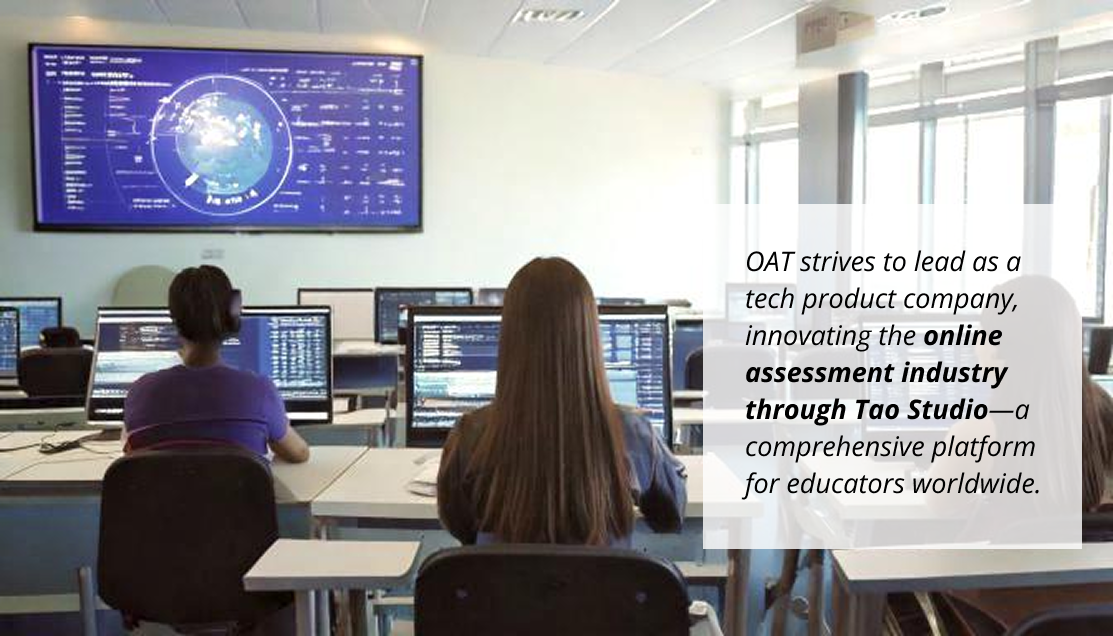
image of future classroom of students in school assessments
CLIENTOpen Assessment Technologies (OAT) – its product suite TAO Studio
SECTOREdTech in B2G K12 (all level of schools before university)

MY ROLESenior UX Lead
SERVICES PROVIDEDStrategic UX planning, discovery workshops, Mixed Method UXR
, training best practices in UX
OFFICESMulti-national – Luxembourg / USA / Spain

The challenge of focus: why serving everyone serves no one

“A lack of direction and focus centred on users is a real deficiency in our wider product teams…”
– OAT Leadership

Open Assessment Technologies (OAT) faced an identity problem. It had long been recognised for its robust and highly customisable education assessment platform, built to accommodate a wide range of bespoke needs. The platform excelled at adapting to the unique requirements of prospective clients. However, in recent years, OAT set its sights on a new direction—transitioning into a SaaS provider with the goal of offering its own suite of digital products and capturing the market.


Digital transformation is a complex journey. While OAT had deep technical expertise, it lacked clarity in key areas: Who were its core users to serve? Which features should take priority? And what would truly drive value?

OAT’s leadership had a clear vision for business growth—expanding market share in the EU for B2G and K-12 while leveraging its core engineering teams to integrate AI and other innovations emerging from the US market. However, achieving these goals required more than just technical capability; it demanded a clear UX and product strategy to drive user adoption. Without a strong understanding of its users and their needs, internal conflicts arose over competing ideas. This misalignment put the company at risk, making it critical to establish a strategic direction that prioritized meaningful user engagement and impact.

UX discovery process used for Tao Studio

image of Discovery process of UXR

UX discovery process used for Tao Studio

image of Discovery process of UXR

Cross-functional workshops for mapping out assumptions & facts Mapping proto-personas to sketch out assumptions from facts Aside from the UX team’s prior insights, we held workshops with cross-functional colleagues to gather opinions. This sparked open debates, revealing rifts and gaps early—just as I prefer. Key discovery: The product does not engage with users until after two critical steps in the assessment cycle. Mapping the current-state customer journey with internal knowledge/assumptions—collaborating with PMs and engineering about the end-to-end User experience. arrow_left Mapping the future-state journey—hypothesising ideal experiences. Tao Studio advances to engage at the first critical stage in the cycle with optimism about feasibility, whereas before, it was uncharted or deemed impossible. arrow_left Cross-functional teammates had conflicting anecdotal info on 15+ user profiles but few facts

Narrowed focus to 3 archetypes, deferring to UXR for evidence-based personas

Most agreed on engaging users earlier but were unsure of business ROI

Clarified UXR planning by identifying key gaps, interview targets, and validation points.
Discovery so far: thumb_down thumb_up thumb_up thumb_up
image of slider Cross functional workshops image of current state customer journey map image of proto persona boards image of future state customer journey map

Leveraging valuable assumptions from cross-functional colleagues—drawing from past work with customers, personas, and documented pain points and gains—helped create a clearer picture of user profiles as starting points. By mapping the current state of a typical journey for key user groups and then envisioning a future-state journey, critical gaps in data emerged.

This process provided clues about who the primary and secondary users were, what OAT assumed their needs to be, and what would genuinely add value—all as working hypotheses. These insights laid the foundation for the UXR team to define key topics and subject areas to explore further through field research.

UXR Planning & Execution

Armed with ideas about our primary and secondary users and their goals, we held additional workshops to articulate and prioritise our key research questions. The slides below showcase artefacts from these workshops throughout the process.

Our key outputs were efficient screening questions and an interview script. After that, we moved into recruitment—finding and booking participants. To maintain velocity, I led the team in running surveys in parallel. The idea was to collect data in the background while we conducted moderated interviews.

Combined both qual (in-depth interviews) and quant (surveys) research methods to gain a more comprehensive understanding of user behaviours, needs, and motivations. We’ve also triangulated the data gathered from sales strategy and industry intelligence reports from the evaluation of previous artefacts/works.

UXR Planning was also workshopped based on identifying and prioritising what we don’t know, what we “think” we know, what we know that we don’t know.
Mixed Method UXR: Qual + quant research
Applying best practices to avoid loaded or leading questions which can contaminate our data collection. This was more an issue for surveys sent out than for 1-2-1 interviews generally. Progressing target learnings to become a script We were looking for educators who actively initiated the assessment cycle, who managed a diverse set of tasks in roles. We discovered that they often have different job titles from our assumptions internally. Eg. vice principals or specialised educators rather than content writers/assessment directors.

Quality screening questions based on User goals were critical in helping us find the right people ultimately were indeed the right fit
Selection based on target goals vs job titles Screening to select interview participants with the right fit - 2 rounds of 6–8 pre-screening/screener questions
- 9 candidates were selected from 1200+ educators reviewed
- 2 rounds of 1 hr interviews with “Assessment coordinator” persona across 6 states in the US

- 1st round of interviews led to discover another key persona to get to know: The State Assessment Director

- Major breakthrough: NY state’s chief assessment director provided an in-depth interview leading to insights
In-depth user interviews
Hundreds of candidates were screened in 2 rounds. Best practices were applied to remove bias from the questions asked– via proof-reading each other's draft questions.
The survey results provided insights from Users (Classroom teachers) who’d use the product in the middle of the assessment creation cycle mainly.
We’ve run surveys in parallel to supplement our qualitative data
Processed data was used to validate and invalidate our assumptions to be either true/false. 100+ respondents in EdTech - US market
image of UXR planning with questions image of UX artifact - key insights from surveys image of target questions image of In depth user interviews image of statistics and charts image of recruiting and screening interview candidates

Combined qual (interviews) and quant (surveys) to understand user behavior, needs, and motivations. Triangulated findings with sales strategy and industry reports.

UXR planning focused on identifying and prioritizing gaps: unknowns, assumptions, and known unknowns.
Mixed Method UXR: Qual + quant research
Progressing target learnings to become a script Applying best practices to avoid loaded or leading questions which can contaminate our data collection. This was more an issue for surveys sent out than for 1-2-1 interviews generally. Screening to select interview participants with the right fit - 2 rounds of 6–8 pre-screener / screener questions

- 9 candidates were selected from 1200+ educators reviewed
In-depth user interviews - 2 rounds of 1 hr interviews with “Donna, District Assessment coordinator” people across 6 states in the US

- Discovery of another key persona to get to know: The State Assessment Director

- Major breakthrough: NY state’s chief assessment director provided an in-depth interview leading to insights
We’ve run surveys in parallel to supplement our qualitative data Hundreds of candidates were screened in 2 rounds. Best practices were applied to remove bias from the questions asked– via proof-reading each other's draft questions.

The survey results provided insights from Users (Classroom teachers) who’d use the product in the middle of the assessment creation cycle mainly.
100+ respondents in EdTech - US market Processed data was used to validate and invalidate our assumptions to be either true/false.
image of UXR planning with questions image of UX artifact - key insights from surveys image of target questions image of In depth user interviews image of statistics and charts image of recruiting and screening interview candidates

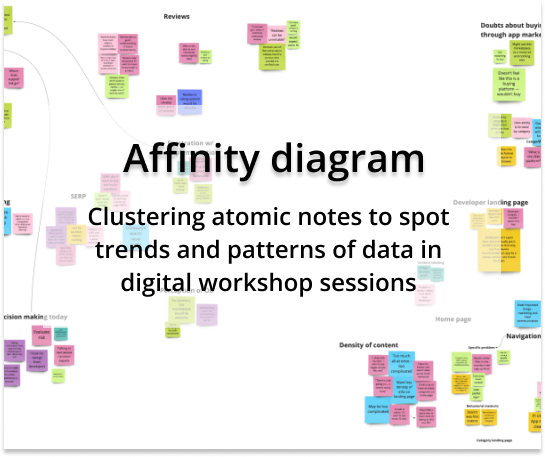
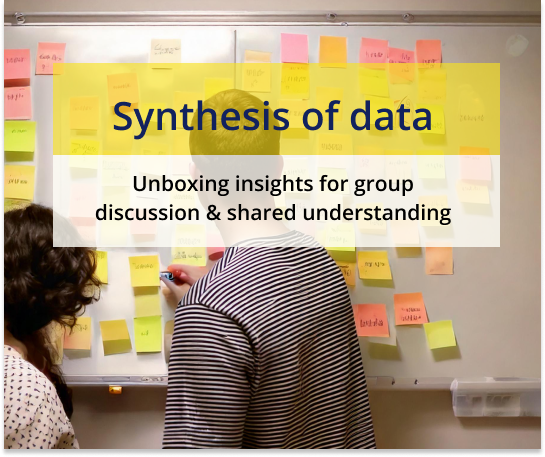
After several rounds of interviews with real users matching the target profiles and personas, the team gathered to process the vast amount of data collected. Using a digital mural board for real-time collaboration, each sentiment or finding was treated as an atomic note, then sorted, clustered, classified, and discussed to ensure a shared understanding across the team. This synthesis and visualization of research artifacts proved invaluable in uncovering emerging sentiment patterns and revealing the real-world challenges that target users face daily.
Analysis of data


image of Affinity diagram
image of Synthesis of data
Sample insight: Key Needs of Schools/Institutions


In the U.S., state laws dictate curriculum standards, which districts must follow—often making interpretation and implementation complex. Providing instructional materials for teachers, including guides, examples, and a list of standards for each item and unit (when creating new questions), would ease this process. This reduces the burden on the Donna persona to find and supply resources for teacher training, ensuring exams are well-structured and free from bias.


How can AI solve real problems for educators using Tao Studio?


Sample insight: Posture towards AI in education varies.

While there are high expectations for AI to reduce time and cognitive load, concerns remain about quality outcomes—especially regarding the sources that feed it. Success largely depends on how this is managed.

Reduction on time on tasks: AI is often perceived as an analysis accelerator, a helpful tool supporting the data analytical tasks that are more time-consuming.

Cognitive load reduction: Curriculum standards, depth of knowledge, competencies, course blue-prints, and accessibility accommodations (special needs of students) are currently taxing heavy cognitive load (short-term memory) on Users of content creation of exams.
 

Uncovering insights to shape business strategy


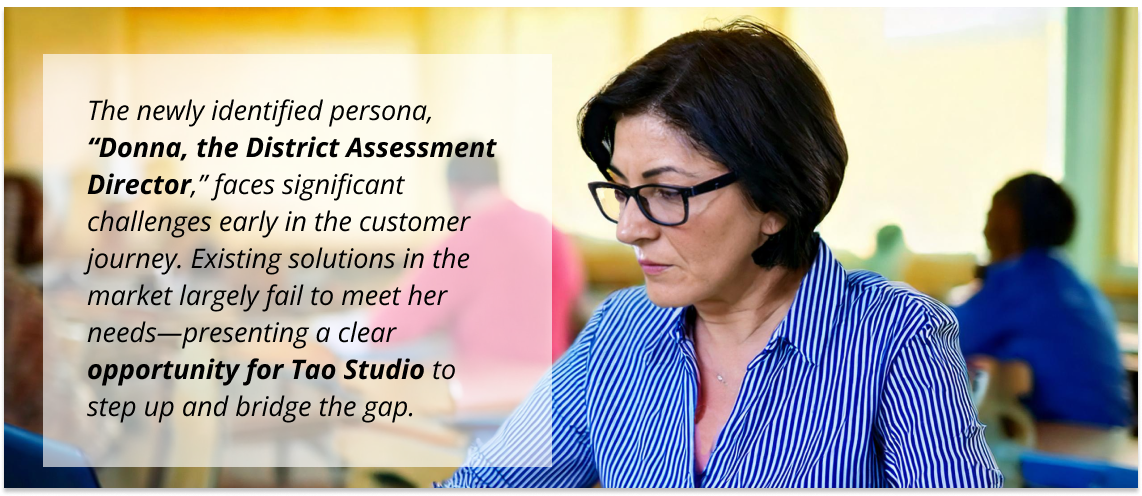
image of Summary of photo persona - district asssessment director

Unsurprisingly, many assumptions from the workshops were validated. However, the field study also uncovered nuanced and unexpected findings—some with the potential to be game-changers in the market.

One critical insight emerged in the initial stages of the customer journey’s assessment cycle: 2 distinct key buyer personas—the District and State Assessment Coordinators—were largely underserved. These personas work together to set the strategic direction for schools, determining district-wide and school-wide policies, selecting tools and technology partners, and shaping the curriculum’s trajectory. The research uncovered 6 key insights into their unmet needs and identified strategic opportunities for OAT to capitalise on moving forward.

Historically, OAT had primarily focused on the middle segment of the journey, catering to a different set of personas. The implication of this continued investment would mean not achieving its business goals.

Additionally, the research highlighted multiple opportunities for Generative AI to address industry-wide gaps, particularly in comparison to competing products like Tao Studio.

By shifting focus to these critical user needs—many of which are feasible to address with conventional technology—OAT could unlock significant value.

A concise insights report was shared with the entire C-suite, including the CEO, equipping them with the information needed to make more informed business decisions on this high-stakes program.
 
 
The research uncovered 6 key insights into their unmet needs and identified strategic opportunities for OAT to capitalise on moving forward.
 
Multiple opportunities for Generative AI to address industry-wide gaps…


Note: Generic images credit – Adobe Firefly. They do not reflect the final solution of study.